


Skip to content

Digital Transformation

How Much Does Digital Transformation Cost in Saudi Arabia?

What actually drives the cost of a digital transformation project — scope, users, licences, implementation, integration, migration, customisation, training and support — and how to build a defensible budget for your own business.

RaysanDev Team15 min read
Two Saudi managers reviewing a phased digital transformation budget and roadmap in a Riyadh office

The honest answer to the cost question is that transformation is priced by scope, not by product. Two companies of the same size can spend very different amounts because one is putting a single sales process into a CRM and the other is replacing finance, inventory and field operations at once. What you can do — before speaking to any vendor — is understand what the money actually buys and build a defensible estimate for your own situation. That is what this guide covers.

Quick Answer

There is no single price for digital transformation in Saudi Arabia. Cost is determined by scope: how many users and departments are involved, which systems you licence, how much implementation and configuration is required, how many integrations and data migrations are needed, how much customisation you commission, and what ongoing support costs after go-live. Budget per phase against a defined scope rather than against a market average.

Key Takeaways

  • Software licences are usually the smallest line in a transformation budget; implementation, integration and migration are usually the largest.
  • Cost scales with scope — users, departments, integrations, exceptions and custom requirements — far more than with company size.
  • A narrow first phase covering one process is the only reliable way to establish a real cost benchmark for your business.
  • The most commonly missed costs are data cleaning, process redesign, internal staff time and the recurring support and licence renewals from year two onward.
  • Judge the spend against the problem it solves: measure a baseline before you start, then compare a small set of KPIs after go-live.

How Much Should a Business Budget for Digital Transformation?

Budget by phase and by scope. A useful figure comes from a defined first phase — one process, a known number of users, a listed set of integrations — not from a market average that has no relationship to your systems. Any number quoted before scope exists is a guess, and the fastest way to reach a real number is to write the scope down. The digital transformation strategy guide covers how to produce that scope; this article covers what it costs to execute it.

A practical way to frame the conversation internally is to work backwards from the loss. If a process costs roughly 40 staff hours a month in re-keying, or a share of leads goes unanswered, you have an annual cost of doing nothing — and a sensible ceiling for what fixing it is worth.

  • Estimate the annual cost of the problem in hours, delayed revenue or rework — even roughly.
  • Define one first phase narrow enough that a vendor can price it precisely.
  • Ask for licences, implementation, integration and first-year support as separate lines.
  • Hold a contingency for exceptions that process mapping always uncovers.
  • Re-forecast the next phase using what the first phase actually cost, not what it was quoted at.

What Determines the Cost of Digital Transformation?

Ten variables account for nearly all the variation between projects. Understanding them lets you read a proposal properly and see where a quote is high because the work is genuinely larger.

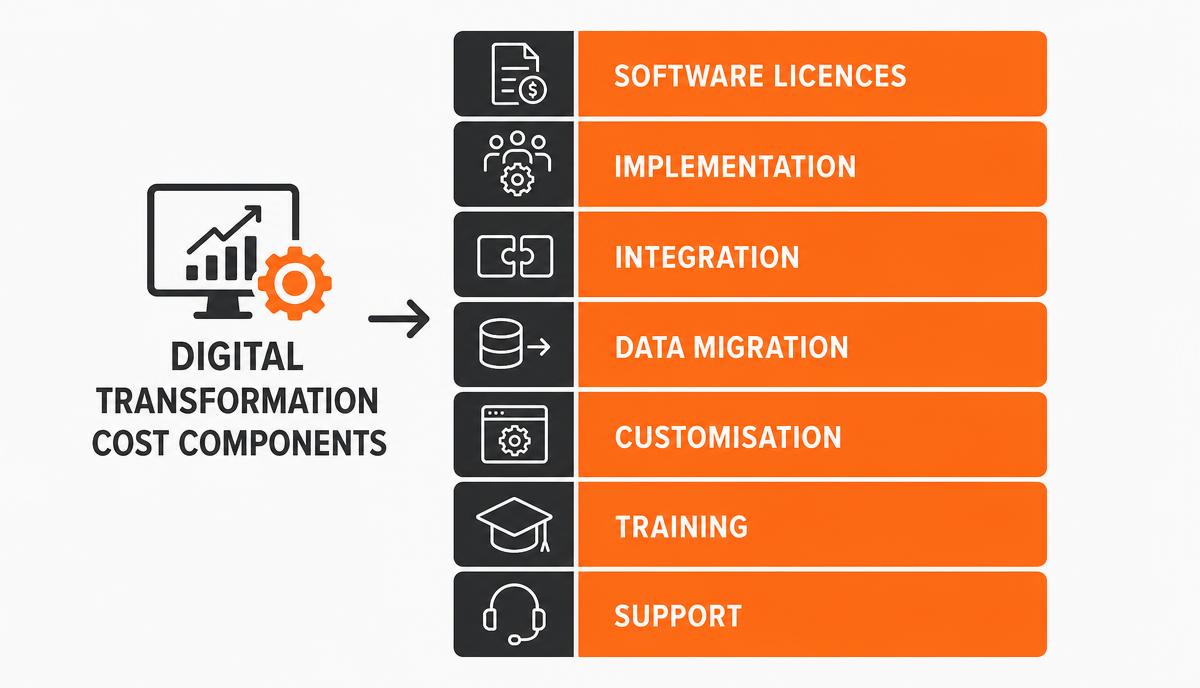
Diagram showing digital transformation cost components: software licences, implementation, integration, data migration, customisation, training and support
The licence line is one component among seven — and rarely the largest.

Business Size and Number of Users

Most platforms price per user per month. The common mistake is licensing everyone at full tier when only a core team works in the system daily; occasional approvers often need a cheaper tier or none. Departments in scope drive cost more than headcount does — three departments means three sets of workflows, permissions and training.

Software and Licensing

Licence cost varies with edition, module count and hosting model, and recurs annually. Check what is included before comparing quotes: some editions charge separately for the modules you actually need, and self-hosted options trade licence fees for infrastructure you then administer yourself.

Implementation

Configuration, workflow build, permissions, document templates and testing usually exceed first-year licence cost. This line reflects your business rather than the product: the more exceptions and approval paths a process has, the more configuration it needs.

System Integration

Every connection between two systems is a small project with its own mapping, error handling and testing. Cost rises with the number of links, whether the endpoints have proper APIs, and how the two systems disagree about the same record. Integration is the most consistently underestimated line in transformation budgets.

Data Migration

Moving records is cheap; cleaning them is not. Duplicate customers, inconsistent Arabic and English naming, missing fields and years of abandoned records must be resolved before import. Migration cost tracks data quality, not volume.

Customisation and Custom Software

Configuring within a product's supported behaviour is inexpensive. Modifying that behaviour is not: every deviation must be re-verified at each upgrade, so it carries a permanent maintenance cost. Custom development is justified when a process is genuinely specific to your business, and expensive when it is used to preserve a habit a standard product could have replaced.

Automation

Automation is priced by rule complexity and exception count, not by the number of tasks removed. A confirmation message triggered by one clear event is quick to build; an approval chain with conditions, escalations and fallbacks is not. WhatsApp automation is often an early candidate because the channel is already where customers are, so adoption costs little.

Artificial Intelligence

Applied AI adds usage-based cost on top of build cost, and it depends on structured data being available first. Classifying incoming requests, extracting fields from documents or drafting replies can pay back quickly at volume — but AI automation layered onto an undocumented process usually produces expensive uncertainty rather than savings.

Training and Change Management

Training cost scales with how much daily routine changes and how many roles are affected, and it is worth funding properly: a well-configured system used by half the team produces worse data than the spreadsheet it replaced. In bilingual teams, budget for materials in the language each department actually works in.

Ongoing Support and Maintenance

From year two the budget becomes recurring: licence renewals, support hours, small workflow changes, upgrades and integration repairs when a connected system changes. Plan it as an annual line from the start.

Typical Digital Transformation Projects

The clearest way to understand cost is to compare scopes rather than prices. The three scenarios below are composites showing how complexity moves a budget — not market price claims.

Illustrative project scopes and what drives their relative cost.
ScenarioScopeMain cost driversRelative budget
1. Small business, first systemCRM for one sales team, lead capture from web and messaging, basic follow-up automation.Licences for a small user count, configuration, light migration, short training.Lowest — a single department, few integrations.
2. Growing companyCRM plus ERP for operations and finance, connected so orders and invoices share one record.Two platforms, multi-department configuration, several integrations, substantial data cleaning.Several times scenario 1 — integration and migration dominate.
3. Complex operationERP, CRM, rule-based automation, applied AI and custom integrations across many departments.Custom development, high exception counts, phased rollout, ongoing AI usage cost.Highest — and the case where phasing matters most.

Headcount is not the main variable between those rows; the number of systems that have to agree with one another is.

Software Cost vs Implementation Cost

Decision-makers anchor on the subscription price because it is the only number published on a website. It is also the number least likely to determine the total.

What each budget line covers and whether it recurs.
LineWhat it pays forRecurring?
Software licencesAccess to the platform, by user and edition.Yes, annually
ImplementationDiscovery, configuration, workflow build, testing, go-live.No
Configuration changesAdjusting workflows as the business changes.Occasional
IntegrationsBuilding and testing links between systems.Mostly one-off, with upkeep
Data migrationExtracting, cleaning, mapping and importing records.No
TrainingRole-based sessions, materials, post-go-live support.Partly, with new staff
SupportHelp desk, fixes, minor changes, upgrades.Yes, annually
CustomisationBehaviour the product does not support natively.Yes, as maintenance

The practical implication when comparing proposals: a lower licence price with a vague implementation line is usually more expensive in year one than a higher licence price with a scoped, itemised implementation. Ask for the split.

The licence is what you buy. The implementation is what you get.
RaysanDev editorial note

Hidden Costs Businesses Often Miss

  • Data cleaning before migration — frequently the largest single task in moving to a new system.
  • Process redesign: deciding how work should run, not just where it is recorded.
  • Internal staff time for workshops, testing and parallel running — real cost, rarely budgeted.
  • Integrations discovered mid-project once teams realise two systems must agree.
  • Requirements that emerge from exceptions nobody mentioned during scoping.
  • Support and licence renewals from year two, including seats added as you hire.
  • Access and security work: roles, permissions, audit trails and offboarding.
  • Headroom for scale — more users, more records, more transaction volume later.

The two that hurt most

Data cleaning and internal time are the costs most often left out of business cases, and together they can change a project's total materially. Estimate both in the planning phase, even roughly, so the approved budget survives contact with reality.

How to Reduce Digital Transformation Costs

  1. Start with the process that costs the most, not the one that is easiest to digitise.
  2. Phase the work so each stage delivers something usable and funds the argument for the next.
  3. Standardise the process before automating it — automating a messy workflow makes the mess faster.
  4. Resist customisation until you have run the standard behaviour and found it genuinely unworkable.
  5. Build only the integrations a process cannot function without; defer the convenient ones.
  6. Licence by role rather than headcount, and review seat counts after the first quarter.
  7. Invest in adoption. Unused licences are the most expensive line in any budget.
  8. Measure against a baseline so the next phase is argued with evidence rather than opinion.

Two savings are not worth taking: skipping data cleaning, which pushes old inconsistencies into a new system and destroys trust in it, and cutting access controls or backups to fit a number. Both return as larger costs.

Should You Transform Everything at Once?

Almost never. Simultaneous change across departments raises cost and risk together and makes results impossible to attribute. Phasing spreads spend across budget cycles and lets each stage prove itself.

  1. Assessment — objectives, current maturity, process maps, priorities and baseline numbers.
  2. Foundation — implement the core system for the priority process, with clean data.
  3. Integration — connect it to whatever must share records, with clear ownership of each record type.
  4. Automation — remove repetitive rule-based steps once the process is stable.
  5. Optimisation — review KPIs against baseline, adjust, then scope the next process.

The order matters as much as the phases: integrate before you automate, and automate before you add AI. Reversing that sequence is the most expensive planning error in transformation work, and it is covered in more depth in the guide to building a transformation strategy.

How to Calculate Your Digital Transformation Budget

Use a planning framework rather than a formula. For a single phase, total budget equals software licences plus implementation plus integrations plus data migration plus customisation plus training plus first-year support, with a contingency on top. It is a checklist that stops lines being forgotten — not a pricing formula, because each term depends on your scope.

  1. Count the users who need daily access, and separately those who only approve or view.
  2. List the systems in scope and every pair that must exchange records.
  3. Assess the state of the data you intend to migrate, honestly.
  4. Write down each requirement no standard product covers, and challenge each one.
  5. Estimate training by role, and the internal hours the project will consume.
  6. Add first-year support, then a contingency for exceptions found during implementation.

Illustrative only

A worked example — say a first phase of a CRM for a small sales team — would still produce a number specific to that company's user count, data quality and integrations. Treat any example figure you see, from any source, as illustrative until it has been quoted against your own written scope.

How to Measure Whether Digital Transformation Is Worth the Cost

Measure return against the problem the phase was meant to solve, using numbers recorded before it started. Pick three or four indicators and review them on a fixed date; a metric that will not change a decision is reporting overhead.

  • Hours saved on manual work, and the share of steps no longer done by hand.
  • Lead response time and the conversion rate of qualified enquiries.
  • Customer response and resolution time for service requests.
  • Error and rework rate: corrections, duplicates, reissued documents.
  • Transactions handled per employee, and cost per transaction.
  • Revenue per employee, where the process is close enough to revenue to be meaningful.
  • System adoption: the share of real transactions recorded in the system rather than beside it.

Adoption is the leading indicator. If it is low three months after go-live, the other numbers describe a half-used process, and the fix is workflow or training, not more capability.

When Does Working With a Technology Partner Make Sense?

Plenty of businesses handle assessment and early configuration internally, and should — nobody understands the process better than the people running it. External help earns its cost in narrower circumstances: when several systems must be integrated, when an ERP or CRM implementation touches multiple departments, when migration is complicated by years of inconsistent records, when automation or applied AI needs building properly, or when a previous rollout failed on adoption.

That is the work RaysanDev does: scoping and phasing, CRM implementation and Odoo ERP, automation, integration and custom development where a standard product genuinely does not fit. A reasonable engagement starts with a scoped assessment and a phased plan you could take to any implementer. If you want a cost range for a specific process, tell us what it involves and we will scope it rather than quote a number blind.

  • Ask for written scope and acceptance criteria before committing to a phase.
  • Ask who holds administrative control of your systems — the answer should be you.
  • Ask what happens after go-live: support, changes and the review cycle.

Conclusion

Digital transformation has no fixed price because it is not a product. The budget follows your objectives, the scope you define, the systems involved, how much integration and migration the work requires, and what support costs once it is live. Understanding those drivers is what turns an unanswerable question into a planning exercise — and the wider guide to transformation sets out the context around it.

The next step is small and concrete: take the single process costing you the most time or revenue, write down what it costs you today, and scope a first phase around it. That page is what makes every cost conversation afterwards a real one.

Related questions

Tags:Digital TransformationBudgetingSaudi ArabiaERPCRMROI

FAQ

Questions about this topic

Insights

Related articles

A Saudi leadership team planning a phased transformation roadmap on a whiteboard in a Riyadh boardroom
Digital Transformation

How to Build a Digital Transformation Strategy for a Saudi Business

A step-by-step method for building a digital transformation strategy: defining objectives, assessing digital maturity, mapping processes, prioritising initiatives, choosing technology, phasing a roadmap, budgeting, preparing people and measuring results.

22 min read
An operations manager presenting an automated workflow diagram to colleagues in a Riyadh office
Digital Transformation

Business Process Automation in Saudi Arabia: A Practical Guide

How Saudi businesses identify, prioritise and implement process automation — which processes to start with, how to choose between CRM, ERP and custom automation, what it costs and how to measure the result.

15 min read

See the full blog or the FAQ library.

Want a cost range for your own first phase?

Tell us which process you would start with. We will come back with a scoped assessment, phases and an itemised view of what it takes.