


Skip to content

Digital Transformation

How to Build a Digital Transformation Strategy for a Saudi Business

A step-by-step method for building a digital transformation strategy: defining objectives, assessing digital maturity, mapping processes, prioritising initiatives, choosing technology, phasing a roadmap, budgeting, preparing people and measuring results.

RaysanDev Team22 min read
A Saudi leadership team planning a phased transformation roadmap on a whiteboard in a Riyadh boardroom

Most transformation programmes do not fail because the software was wrong. They fail because nobody wrote down what the business was trying to change before the software was chosen. A strategy is the document that prevents that: it states the outcomes, the order of work and the way results will be judged. This guide walks through building one for an operating company — the questions to ask, the frameworks to fill in, and the decisions that have to be made before anyone opens a vendor demo.

Quick Answer

Build a digital transformation strategy by defining the business outcomes you need, assessing your current digital maturity, mapping the processes involved, and prioritising initiatives by impact against effort. Only then choose technology — CRM, ERP, automation, AI, integration or custom software — and sequence it into a phased roadmap with a budget, an adoption plan and a small set of measurable KPIs.

Key Takeaways

  • A strategy is a written set of business outcomes, priorities and sequencing — not a shortlist of products.
  • Assess digital maturity honestly first; the correct next step for a spreadsheet-run company is different from one with connected systems.
  • Map processes before selecting software, then prioritise by business impact against implementation effort.
  • Phase the roadmap: assessment, foundation, integration, automation, optimisation — each phase producing something usable.
  • Adoption and a handful of baselined KPIs decide whether the investment returns anything; both belong in the strategy, not after go-live.

What Is a Digital Transformation Strategy?

A digital transformation strategy is a written plan that states which business outcomes the company is pursuing, which processes will change to achieve them, in what order the work happens, what it will cost, and how success will be measured. It is a management document. The technology choices sit inside it as consequences, not as its subject matter. If you want the broader background on what transformation involves as a whole, the practical guide to digital transformation in Saudi Arabia covers the landscape; this article is about producing the plan itself.

The distinction that matters most is between a strategy and a purchase. A purchase answers 'which system should we buy?'. A strategy answers 'what should be true about how this company operates in eighteen months, and what is the shortest credible path there?'. The second question usually reveals that two of the five things on the wish list are urgent, two can wait a year, and one is not a technology problem at all.

  • A strategy names outcomes in business language: response time, order accuracy, closing the month faster.
  • It states the order of work, so that teams are not asked to absorb four system changes at once.
  • It defines ownership — who is accountable for each process after the technology changes.
  • It sets a measurement baseline before anything is implemented.
  • It is revised on a schedule, because conditions and priorities move.
A strategy is the reason you can say no to a good product that solves a problem you do not currently have.
RaysanDev editorial note

Why Businesses Need a Digital Transformation Strategy

Companies that skip the strategy stage tend to end up with the same recognisable pattern: three or four systems bought at different times by different departments, none of which talk to each other, each holding a partial version of the truth. Every subsequent improvement then costs more than it should, because the first job is always reconciling data that should never have diverged.

A written strategy protects against that in seven practical ways:

  • Efficiency: it targets the processes where manual effort is genuinely concentrated, rather than the ones that are easiest to digitise.
  • Customer experience: it makes response time and service consistency explicit goals, which is where most B2B deals are won or lost.
  • Scalability: it forces the question of what breaks at three times current volume, before that volume arrives.
  • Data: it establishes which system owns which record, which is the only durable defence against contradictory numbers.
  • Automation: it sequences automation after process documentation, so you are not automating an undefined workflow.
  • Employee productivity: it accounts for the training and adoption effort that determines whether new tools are actually used.
  • Competitiveness: it lets leadership commit budget to a sequence rather than to a series of unrelated reactions.

None of this requires a large company or a dedicated transformation office. For a business with thirty to three hundred people, the strategy can reasonably be ten to fifteen pages, owned by one executive who has the authority to change how work is done.

Step 1: Define Your Business Objectives

Start with outcomes, not systems. An objective is useful when it names a measurable business condition and a rough time frame. 'Implement a CRM' is not an objective; it is a possible answer to one. 'Respond to every qualified enquiry within two working hours, and know at any moment what is in the pipeline' is an objective — and it may or may not require a CRM.

Useful objectives usually come from one of four pressures: revenue that is being lost somewhere visible, cost that scales badly with volume, a service commitment that cannot currently be kept, or a compliance requirement that has to be met regardless. Write three to five, no more. A list of twelve objectives is a wish list, and it will not survive the first budget conversation.

  1. Commercial example: cut the time between an enquiry arriving and a human replying, and stop losing enquiries that arrive outside working hours.
  2. Operational example: eliminate the re-entry of order data between the sales sheet, the warehouse log and the accounting file.
  3. Financial example: close the month in five working days instead of fifteen, with figures leadership trusts without manual checking.
  4. Service example: give customers a reliable status answer without a staff member having to phone the operations team.
  5. Compliance example: issue and archive invoices in a way that satisfies e-invoicing obligations without a parallel manual process.

Attach a number to each objective

Even an approximate current figure is enough — 'roughly two days to reply', 'about 40 hours a month spent re-typing orders'. Without a baseline you will not be able to tell later whether the project worked, and the debate will be settled by opinion.

Step 2: Assess Your Current Digital Maturity

Digital maturity describes how far the company's operations already run through connected systems. It matters because the correct next step is completely different at each level. Advising a spreadsheet-run business to invest in AI is as unhelpful as advising a company with integrated systems to start by digitising documents.

A practical five-level digital maturity assessment.
LevelWhat it looks likeTypical symptomsSensible next move
1. ManualWork runs on paper, spreadsheets, email and WhatsApp; knowledge lives with individuals.Nothing can be answered without asking a specific person; records disagree.Digitise one core record set and put a single process into a real system.
2. Disconnected systemsSeveral tools exist, each owned by one department, none exchanging data.The same customer or order is re-entered two or three times.Decide which system owns which record, then connect the two most costly gaps.
3. Partially digitisedCore transactions are in systems, but approvals, exceptions and reporting are still manual.Month-end is assembled by hand; exceptions escape the system entirely.Complete the process end to end rather than adding another tool.
4. IntegratedSystems share data reliably; one record flows through sales, operations and finance.Data is trusted, but staff still perform repetitive predictable steps.Automate high-volume rule-based steps and standardise reporting.
5. Automated and data-drivenRoutine work runs without intervention; decisions use current data.Improvement is incremental; the constraint is insight, not plumbing.Apply forecasting, applied AI and continuous optimisation where volume justifies it.

Assess by department rather than as one company score. It is normal for finance to sit at level three while field operations sit at level one. The strategy should raise the level of the department that is costing the business most, not the one that is easiest to improve.

Step 3: Map Your Business Processes

Process mapping means writing down, step by step, how work actually moves today — including the informal steps everyone knows about and nobody documents. For each step, record who performs it, what triggers it, what system or file it touches, how long it takes and where it commonly stalls. A whiteboard session with the people who do the work produces a better map than any consultant's template.

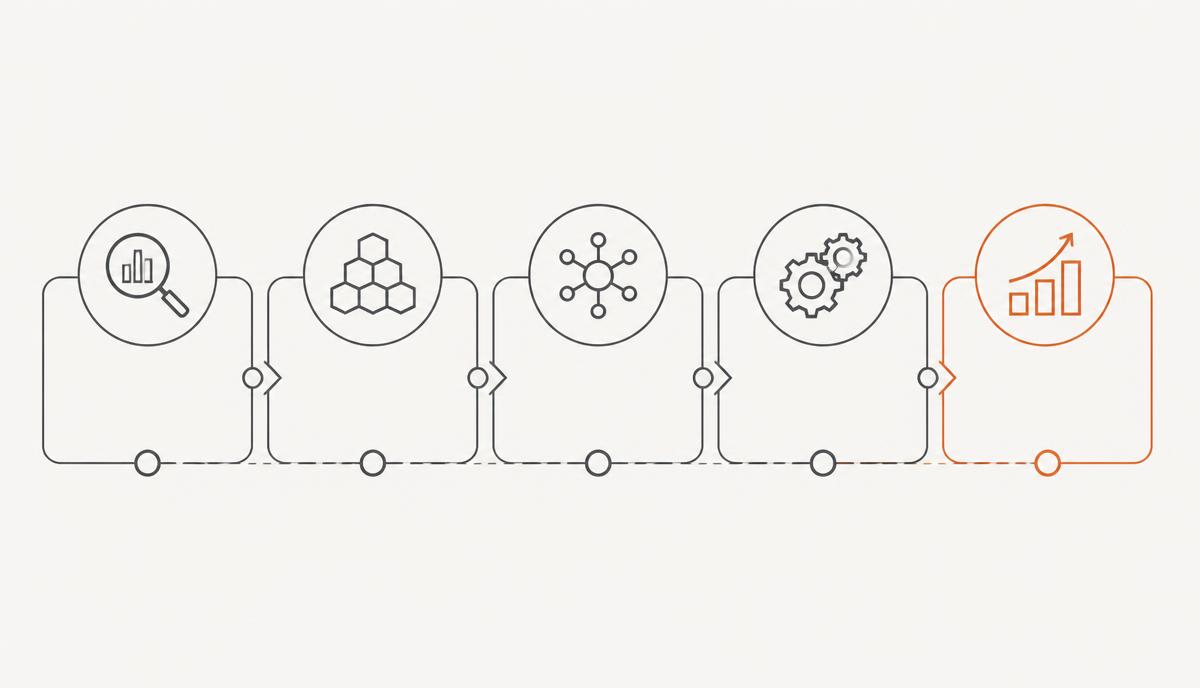
Illustration of a five-phase digital transformation roadmap from assessment through foundation, integration and automation to optimisation
Mapping comes first; the phased roadmap in Step 6 is assembled from what the maps reveal.

Map the processes that touch money, customers or capacity first. In most mid-sized companies that means these six:

Where to focus process mapping, and what usually turns up.
ProcessMap from → toCommon failure point
SalesEnquiry received → quotation → order confirmedEnquiries arriving across several channels with no single owner or follow-up rule.
Customer supportRequest received → assignment → resolution → confirmationRequests tracked in personal inboxes, so status cannot be answered without asking.
FinanceOrder → invoice → collection → reconciliationInvoices raised from data re-typed out of another system, creating mismatches.
HRRequest or onboarding → approval → record updateApprovals by message with no audit trail; records kept in parallel files.
OperationsJob scheduled → executed → verified → closedField updates arriving as photos and voice notes that never reach the system.
ProcurementRequirement → approval → purchase order → receiptPurchases committed before approval, discovered only at invoice stage.

Two questions are worth asking at every step: does this step add value, or does it exist because a previous system could not do something? And who would notice if it disappeared tomorrow? A surprising number of steps survive only through habit, and removing them costs nothing.

Step 4: Identify the Highest-Value Opportunities

Mapping produces more candidate improvements than any company can fund at once. Prioritisation turns that list into a sequence. Score each candidate initiative on a simple one-to-five scale across seven factors, then compare business impact against implementation effort.

A seven-factor prioritisation framework for transformation initiatives.
FactorQuestion to answerWeight in practice
Business impactHow much revenue, cost or capacity does this affect?Highest
Implementation effortHow many systems, teams and data sets are involved?Highest
CostLicences, implementation, integration and internal time combined.High
UrgencyIs there a deadline, a contract or an obligation forcing it?High
Customer impactWould a customer notice the difference?Medium
Employee impactHow much repetitive work does it remove, and who has to change habits?Medium
RiskWhat breaks if this goes wrong, and can it be reversed?Medium

Plot the results on a simple grid. High impact with low effort is where the first phase belongs — these projects fund credibility for everything that follows. High impact with high effort should be scheduled deliberately, with a business case and executive sponsorship. Low impact with low effort can be done opportunistically. Low impact with high effort should be declined in writing, so it does not reappear at every planning meeting.

Pick one first initiative, not three

A single completed process change with measured results does more for internal support than three half-finished ones. Sequential delivery is also easier to fund, because each phase produces evidence for the next.

Step 5: Decide What Technology You Actually Need

Only now does the technology conversation make sense, because the requirements are written down. Most companies need two or three of the categories below — not all six. The solutions overview groups them by the business outcome they serve, which is a more useful way to compare them than by feature list.

CRM

A CRM holds the customer relationship: every lead, contact, conversation and open opportunity, with a defined stage and owner. Choose it when enquiries are being lost, follow-up depends on memory, or nobody can state the current pipeline. In this market a CRM implementation is only complete if it captures messaging conversations as well as calls and email, because that is where much of the relationship actually happens.

ERP

An ERP runs the work behind the sale: inventory, purchasing, projects, invoicing and accounting on one data model. Choose it when stock, cost or invoicing figures disagree between departments, or when finance is assembled from exports. Odoo is a common starting point for mid-sized companies because modules can be adopted in stages rather than all at once.

Business Process Automation

Automation removes human steps from processes that are already digital: order confirmations, escalation of unanswered requests, recurring invoices, scheduled reminders. It is the fastest route to a visible result when the process is documented and the rules are clear. WhatsApp automation is frequently the highest-return first project here, because it turns the channel customers already use into an operational one.

AI

Applied AI is useful where judgement is repetitive and inputs are unstructured — classifying incoming requests, extracting fields from documents, drafting first-pass responses, summarising long threads. It depends on data that is already organised, which is why it rarely belongs in phase one. Treat AI automation as an accelerator for a working process, not a replacement for one.

Custom Software

Build only where the process is genuinely specific to your business and no configurable product fits without heavy distortion — a specialised operational workflow, a customer portal tied to your own logic, an internal tool no vendor serves. Custom development carries ongoing ownership costs, so it should be a deliberate decision rather than the result of failing to configure a standard system.

System Integration

Integration is what makes the rest coherent: the CRM knowing an order was delivered, the ERP knowing a deal closed, the messaging layer reading real status. It is routinely underestimated in both budget and time, and it is the single most common reason a technically successful implementation still feels like extra work to staff.

Step 6: Build a Digital Transformation Roadmap

The roadmap turns priorities into a sequence with dates and deliverables. Structure it in phases where each phase produces something usable on its own — a phase that only makes sense once the next one is finished is a dependency, not a phase.

A five-phase transformation roadmap and what each phase should deliver.
PhaseFocusDeliverable
Phase 1 — AssessmentObjectives, maturity, process maps, prioritisation, baseline metrics.A written strategy with an agreed first initiative and success measures.
Phase 2 — FoundationImplement the core system for the prioritised process; clean and migrate the data it depends on.One process running end to end in a real system with trusted data.
Phase 3 — IntegrationConnect the new system to the others that must share records; define ownership per record type.No duplicate entry between the connected systems.
Phase 4 — AutomationAutomate repetitive rule-based steps; add notifications, escalation and scheduled tasks.Measurable reduction in manual handling time for the mapped process.
Phase 5 — OptimisationReview KPIs against baseline, refine workflows, extend to the next prioritised process.A measured result and a scoped next phase.

Attach an owner and a realistic date to each phase, and accept that dates move. What should not move is the order: integration before automation, and automation before AI. Reversing that order is the most expensive sequencing error in transformation work.

Step 7: Budget for Implementation

Transformation budgets are driven by scope, not by a market rate, so any figure quoted before scoping is a guess. What you can do reliably is understand the cost drivers and build your own reference from a first, deliberately narrow phase.

  • Software licences: usually per user per month, and sensitive to how many occasional users you include.
  • Implementation: configuration, workflow setup and testing — commonly larger than the licence cost in year one.
  • Integrations: each connection between systems is its own small project, with its own testing and failure handling.
  • Customisation: anything that departs from standard behaviour, and which has to be re-verified at every upgrade.
  • Data migration: strongly influenced by data quality; cleaning is often the larger half of this line.
  • Training: proportional to how much the daily routine changes, not to system complexity.
  • Support and maintenance: an ongoing annual line, not a one-off.
  • AI and automation complexity: proportional to the number of exceptions and the quality of the underlying data.

Two budgeting habits help in practice. First, budget internal time as a real cost — the staff hours spent in workshops, testing and parallel running are the most commonly missed line. Second, keep a contingency for the discoveries that process mapping always produces, because the exceptions nobody mentioned are found during implementation, not before it.

Step 8: Prepare Employees for Change

Adoption is not a training session at the end. It is a stream of work that runs alongside implementation, and it is where most of the value is won or lost. A well-configured system used by half the team produces worse data than the spreadsheet it replaced, because now two versions of the truth exist.

  • Communication: explain what is changing and why, in terms of the work people actually do, before anything appears on their screen.
  • Involvement: include the people who perform the process in the mapping stage; they will find the exceptions no manager remembers.
  • Training: short, role-specific and repeated, using the company's own data rather than demo records.
  • Process ownership: name one person accountable for each process after go-live, with the authority to change it.
  • Management support: leadership has to use the system's reports rather than requesting the old spreadsheet, or the old spreadsheet survives.
  • Retiring the old way: schedule the shutdown of the previous method explicitly; parallel running without an end date becomes permanent.

Expect a short productivity dip immediately after go-live. Planning for it — lighter workloads, visible support, a fast channel for fixing early friction — is the difference between a dip and a rollback.

Step 9: Measure Results

Choose three or four KPIs tied directly to the objectives from Step 1, record the baseline before implementation starts, and review them on a fixed schedule. Metrics that will not change a decision are reporting overhead.

  • Processing time: from request received to work completed.
  • Lead response time: minutes or hours between an enquiry arriving and a human reply.
  • Conversion rate: qualified enquiries that become orders.
  • Customer response and resolution time for service requests.
  • Error and rework rate: corrections, duplicate records, reissued documents.
  • Employee productivity: transactions per person, or hours recovered from removed manual work.
  • Cost per transaction: total processing cost divided by volume.
  • System adoption: the share of real transactions recorded inside the system rather than beside it.

Adoption is the earliest honest signal. If it is low three months after go-live, the other numbers are describing a process that only partly exists, and the right response is to fix the workflow or the training rather than to add more features.

Common Digital Transformation Strategy Mistakes

  • Buying software before defining the problem, which converts a business question into a configuration exercise.
  • Transforming everything at once, which exhausts the team and makes it impossible to attribute results.
  • Excessive customisation, which raises cost, complicates upgrades and usually preserves a process that should have changed.
  • Ignoring employees, which produces a technically live system that nobody uses consistently.
  • Leaving systems disconnected, which recreates manual re-entry in a more expensive form.
  • Migrating poor data, which transfers old contradictions into a new system and undermines trust immediately.
  • Defining no KPIs and no baseline, which makes the outcome a matter of opinion.
  • Treating AI as a magic solution, when its usefulness depends entirely on the data and processes underneath it.

Almost all of these share one root cause: the sequence was inverted. Technology was selected before outcomes, processes and priorities were written down.

A Practical 90-Day Starting Plan

Ninety days is long enough to produce a real change and short enough to hold attention. This plan assumes one prioritised process, not a company-wide programme.

  1. Days 1–15: agree three to five objectives with leadership, complete the maturity assessment by department, and record current baseline figures.
  2. Days 16–30: map the two or three processes behind the objectives, score initiatives on the prioritisation framework, and select one first initiative.
  3. Days 31–45: define requirements from the map, evaluate options against those requirements, and agree scope, budget and phase dates.
  4. Days 46–70: implement the chosen system for that process, clean and migrate the data it needs, and build the integrations it cannot work without.
  5. Days 71–85: train the daily users on real data, run in parallel briefly, then retire the old method on an agreed date.
  6. Days 86–90: compare KPIs against the baseline, document what the map got wrong, and scope the next phase.

The output of 90 days

One process genuinely running in a system, a measured comparison against a baseline, and a written next phase. That is a defensible foundation for a multi-year programme — and it is achievable without pausing the business.

When Should You Work With a Technology Partner?

Plenty of companies complete the first two or three steps internally, and they should: nobody understands the processes better than the people running them. External help earns its cost in narrower circumstances — when several systems must be integrated, when data migration is complicated by years of inconsistent records, when the internal team has no capacity to run an implementation alongside daily work, or when the company has already attempted a rollout that did not achieve adoption.

This is the work RaysanDev does: strategy and scoping, CRM and ERP implementation, process automation, applied AI, system integration and custom development where a standard product genuinely does not fit. A reasonable engagement starts with a scoped assessment and a phased plan you could take to any implementer — if a proposal begins with a licence count instead of your processes, that is a signal worth acting on. If you want to discuss a specific process, get in touch.

  • Ask for a written scope with acceptance criteria before committing to a phase.
  • Ask who owns the administrative access to your systems — the answer should be you.
  • Ask what happens after go-live: support, changes and the improvement cycle.

Conclusion

A digital transformation strategy is a sequence of decisions, made in a specific order: objectives, maturity, processes, priorities, technology, roadmap, budget, people, measurement. Followed in that order, the technology question becomes straightforward, because the requirements are already written. Followed in reverse, every step afterwards is spent compensating for a choice made too early.

The practical next step is small. Take the single process that costs you the most time or the most revenue, map it honestly with the people who run it, and record what it currently costs. That one page is the beginning of the strategy, and it is enough to make the rest of the plan concrete.

Related questions

Tags:Digital TransformationStrategySaudi ArabiaCRMERPAutomation

FAQ

Questions about this topic

Insights

Related articles

Two Saudi managers reviewing a phased digital transformation budget and roadmap in a Riyadh office
Digital Transformation

How Much Does Digital Transformation Cost in Saudi Arabia?

What actually drives the cost of a digital transformation project — scope, users, licences, implementation, integration, migration, customisation, training and support — and how to build a defensible budget for your own business.

15 min read
An operations manager presenting an automated workflow diagram to colleagues in a Riyadh office
Digital Transformation

Business Process Automation in Saudi Arabia: A Practical Guide

How Saudi businesses identify, prioritise and implement process automation — which processes to start with, how to choose between CRM, ERP and custom automation, what it costs and how to measure the result.

15 min read

See the full blog or the FAQ library.

Turning a strategy into a first phase?

Tell us which process you would start with. We will come back with a scoped assessment, phases and a realistic timeline.