


Skip to content

CRM

How Much Does CRM Implementation Cost in Saudi Arabia?

What actually drives CRM cost in Saudi Arabia — licences, implementation, data migration, integrations, automation, training and ongoing support — and how to compare quotations without being misled by the licence price.

RaysanDev Team12 min read
A finance and operations manager reviewing a CRM implementation budget breakdown on a desk

CRM pricing looks simple until you request quotations. One vendor quotes a monthly figure per user, another quotes a project fee, and a third quotes both plus an annual support retainer — and none of the three are describing the same scope. This article explains what a CRM actually costs a Saudi business, which variables move the number, and how to compare proposals so the cheapest quotation is not simply the least complete one.

Quick Answer

CRM cost in Saudi Arabia has two parts: recurring licences priced per user per month, and a one-off implementation covering configuration, data migration, integrations, automation and training. Licences are usually the smaller number. The cost drivers are user count, how many systems must be integrated, the condition of your existing customer data, and how much customisation you commission beyond standard configuration.

Key Takeaways

  • Licence price is the visible cost; implementation, integration and data migration usually cost more.
  • The largest single variable is integration — every connected system adds scope, testing and maintenance.
  • Dirty customer data can cost more to clean than the CRM costs to configure.
  • Budget for year two: licences and support continue after implementation ends.
  • Compare quotations line by line, not by total, or you will select the least complete scope.

The Two Parts of CRM Cost

Every CRM budget separates into recurring cost and one-off cost. Recurring cost is licensing, usually per user per month, sometimes with tiers that unlock automation, permissions or API access. One-off cost is the implementation project: process definition, configuration, data migration, integrations, automation, training and go-live support.

The common budgeting mistake is treating the licence as the decision and the implementation as a detail. In most projects the ratio is the other way round in the first year, particularly for businesses with fewer than fifty users, where licences are modest but the work of making the system fit the business is not. If the scope itself is still open — whether you are buying a CRM or an operations system — settle whether you need a CRM or an ERP before pricing anything, because the two carry very different implementation profiles.

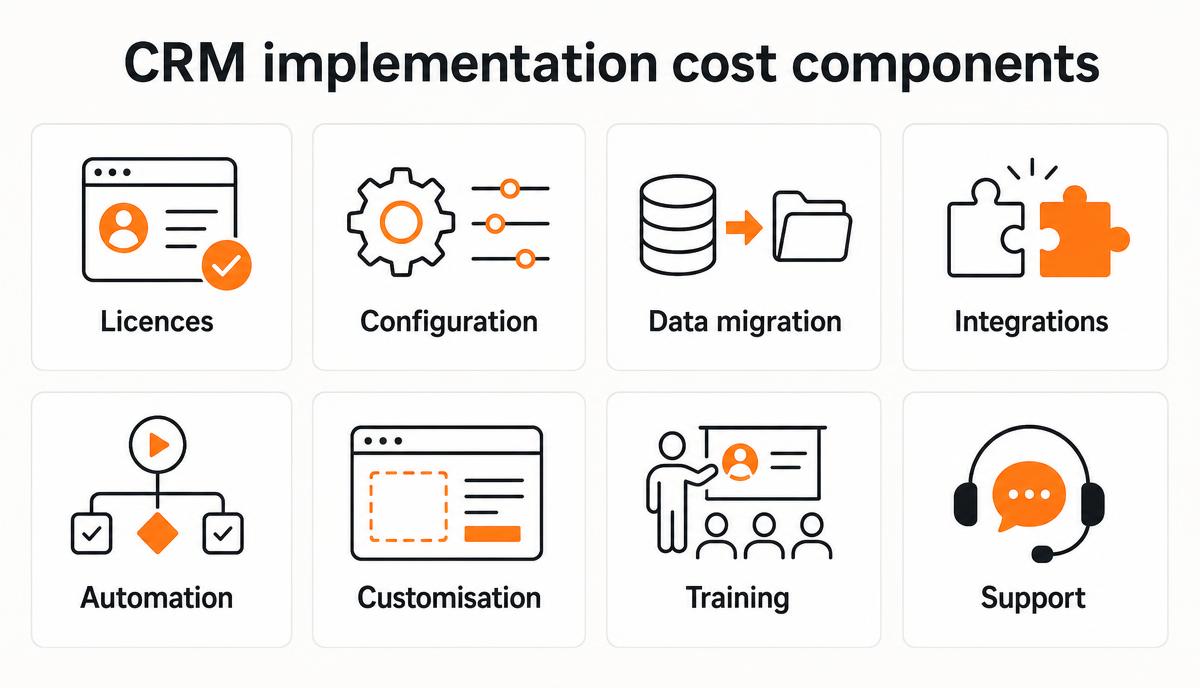
Diagram showing CRM cost split into licences, implementation, data migration, integrations, automation, training and ongoing support
Where CRM budget actually goes in the first year.

Licence Cost

Licences scale with users and with the tier you need. Three details cause more budget surprises than the headline price: which features sit behind a higher tier, whether the price is per named user or per active user, and whether the quoted rate is annual-commitment pricing rather than monthly.

  • Confirm whether automation, permission control and API access are included in your tier.
  • Ask which roles genuinely need a licence — some read-only stakeholders may not.
  • Check the renewal price, not only the first-year price.
  • Confirm the currency and whether VAT is included in the quoted figure.

Implementation Cost

Implementation is professional services: mapping your sales and service process, configuring pipelines, fields, permissions and templates, and validating that the configuration matches how the team actually works. Scope drives price directly — a single sales team with one pipeline is a fraction of the work of a multi-branch rollout with separate sales, service and management views. The same scoping logic applies across any digital transformation project.

Cost tracks the number of processes and departments involved, not the number of features enabled.
ScopeTypical workRelative cost
Single team, standard pipelineConfiguration, basic reports, trainingLowest
Sales plus serviceTwo process designs, shared records, permissionsModerate
Multi-branch or multi-entityData segregation, role design, consolidated reportingHigh
Sales, service, marketing and managementFull process design, attribution, dashboardsHighest

Data Migration Cost

This is the line most often underestimated. Exporting records is trivial; making them usable is not. Duplicate companies under three spellings, contacts without owners, phone numbers in five formats, and deals with no close date all have to be resolved before migration, or the CRM inherits the problem and the team stops trusting it in week one. Our guide to CRM migration from spreadsheets and legacy systems walks through the sequence and what drives the effort.

A cheaper option exists

Migrating only active customers and open deals, and archiving the rest as a read-only file, removes most of the cleaning effort. Very few businesses genuinely need eight years of dead leads inside the new system.

Integration Cost

Integration is the largest swing factor. A standard connector configured to a documented API is modest. A custom integration to an older accounting system, or a two-way sync where both systems can change the same record, is a build with its own testing and maintenance. WhatsApp through the Business API — usually the highest-value integration for a Saudi business — is covered on our WhatsApp automation page, and ERP connections are discussed under Odoo ERP.

  • Website and form capture: usually simple and quick.
  • WhatsApp Business API: setup, number verification, templates and routing.
  • Email and calendar: standard, low effort.
  • Accounting or ERP: cost depends on API quality and whether sync is one-way or two-way.
  • Legacy or in-house systems: quoted as a build, not as a connector.

Ask every vendor to price integrations individually. A single line reading "integrations" hides the difference between a two-day connector and a three-week build.

Automation and Customisation Cost

Basic automation — lead assignment, follow-up creation, reminders, escalation — is normally configuration and adds little. Cost rises when the requirement is a custom object, an approval workflow with conditional routing, a document generator with specific layouts, or a screen the product does not provide. That is where custom development enters the budget, and it should be limited to what genuinely does not fit.

Every customisation is bought twice: once when it is built, and again each time the platform updates and it has to be retested.

Training, Support and Year Two

Training is small relative to the rest and disproportionately affects whether the investment returns anything. Budget for role-based sessions in the language each team works in, plus a short refresher after 30 days when real questions have surfaced.

Support is recurring. Decide whether you need a retainer for changes and questions, or whether an internal owner can maintain the configuration with occasional vendor help. Then build a year-two budget: licences, support, and the changes the business will inevitably request once people are using the system properly.

What Moves the Number Most

DriverEffect on costHow to control it
Number of usersDirect, recurringLicence only the roles that need write access
Number of integrationsLarge, one-off plus maintenancePhase them; start with the highest-volume channel
Data conditionCan exceed configuration costMigrate active records only; archive the rest
CustomisationHigh, and recurring in maintenanceAccept standard behaviour unless it blocks the process
Number of departmentsMultiplies process design workRoll out one department at a time
Process clarityUnclear process inflates every lineDefine the process before requesting quotations

How to Compare CRM Quotations

  1. Send every vendor the same written scope: processes, integrations, user count, data volume.
  2. Require separate lines for licences, implementation, migration, each integration, training and support.
  3. Ask what is explicitly excluded — that answer is more revealing than the total.
  4. Ask for the year-two cost in writing.
  5. Confirm who owns the data and the admin credentials at the end of the project.
  6. Ask what happens if the scope changes mid-project, and how that is priced.

The cheapest quotation is usually the least specific one

If a proposal does not name your integrations, your data volume and your processes, it is not priced for your project — it is priced to be selected.

How to Reduce CRM Cost Without Undermining the Project

  • Define the sales process internally before engaging a vendor — clarity is free and reduces every other line.
  • Start with one team and one pipeline, then extend once the pattern works.
  • Clean your own data where you can; you know which customers are real.
  • Phase integrations by message volume rather than connecting everything at once.
  • Accept standard product behaviour unless it genuinely blocks the process.
  • Name an internal owner so routine changes do not become billable requests.

The broader question of what a CRM should do before you price it is covered in our complete CRM guide for Saudi businesses.

Cloud or Self-Hosted: What It Does to the Budget

Cloud CRM converts the whole question into a subscription: the vendor runs the servers, applies updates, handles backups and absorbs the security work. Self-hosting removes the subscription and replaces it with infrastructure, patching, backup verification, uptime monitoring and someone competent to own all of it. For a business under a few hundred users the arithmetic almost always favours cloud, and the exceptions are driven by data-control or regulatory requirements rather than by price.

If data residency is the reason for considering self-hosting, ask the cloud vendor where data is stored and what contractual commitments exist before assuming you must run it yourself. The answer often removes the requirement, and with it a permanent line of internal cost.

  • Cloud: predictable recurring cost, no infrastructure work, upgrades included.
  • Self-hosted: no licence subscription, but servers, maintenance, security and internal ownership become real budget lines.
  • Either way, integration and data-migration costs are effectively the same.

What a Sensible First Phase Actually Includes

Most cost overruns come from trying to launch everything at once. A first phase that is deliberately narrow costs less, goes live sooner, and gives you evidence before you commit further budget. It should be complete enough to run real business, not a pilot that nobody depends on.

Phasing spreads cost across budget periods and reduces the risk of paying for unused configuration.
PhaseIncludedWhy it is sequenced here
Phase 1One team, one pipeline, lead capture, follow-up automation, core reportsProves adoption before scope grows
Phase 2Highest-volume channel integration, usually WhatsAppAdds the most operational value once habits exist
Phase 3Accounting or ERP connection, quotations and invoicesRequires stable data and agreed ownership rules
Phase 4Service desk, marketing attribution, advanced dashboardsOnly worth building on trustworthy data

This sequence also protects the implementation budget in a practical way: each phase is quoted against a scope you now understand from experience rather than from a proposal, so the estimates get more accurate as the amounts get larger.

Costs That Appear After the Quotation

A handful of costs are genuinely predictable but rarely appear in a proposal, because they are yours rather than the vendor's. Planning for them is what separates a budget that holds from one that is revised twice.

  • Internal time: your team's hours in process definition, data review, testing and training are real cost even when uninvoiced.
  • Messaging charges: WhatsApp Business API conversations are billed per conversation, independently of the CRM licence.
  • Additional users: growth after go-live raises the recurring line, sometimes mid-contract.
  • Change requests: the useful ones arrive after three months of real use, once people know what they actually need.
  • Retraining: staff turnover means the training cost recurs quietly unless someone internal can deliver it.
  • Storage and attachments: high document volumes can move you to a higher tier.

Plan the second year deliberately

Write a year-two figure at the same time as the year-one budget: licences, support, messaging and a modest allowance for changes. Projects rarely fail financially in year one — they fail when year two arrives unbudgeted.

Conclusion

A CRM budget is predictable once the scope is written down. Licences follow user count, implementation follows the number of processes and departments, and the variance sits almost entirely in integrations and data condition. Define the process, phase the rollout, and require itemised quotations — then the number stops being a surprise. If you want a scoped estimate against your own situation, describe how your team sells today.

Related questions

Tags:CRMCostBudgetingSaudi ArabiaImplementation

FAQ

Questions about this topic

Insights

Related articles

Two Saudi managers reviewing a phased digital transformation budget and roadmap in a Riyadh office
Digital Transformation

How Much Does Digital Transformation Cost in Saudi Arabia?

What actually drives the cost of a digital transformation project — scope, users, licences, implementation, integration, migration, customisation, training and support — and how to build a defensible budget for your own business.

15 min read
An operations manager presenting an automated workflow diagram to colleagues in a Riyadh office
Digital Transformation

Business Process Automation in Saudi Arabia: A Practical Guide

How Saudi businesses identify, prioritise and implement process automation — which processes to start with, how to choose between CRM, ERP and custom automation, what it costs and how to measure the result.

15 min read

See the full blog or the FAQ library.

Want a realistic CRM budget?

Tell us your team size, the systems you need connected and the state of your customer data. We will come back with an itemised scope and cost range.